They tried to tell us SEO was dead after the Panda update. They tried to tell us SEO was dead after the Penguin update. They tried to tell us SEO was dead when voice search came on to the scene. Not long ago, they tried to tell us SEO was dead when zero-click searches and AI Overviews became common features on informational SERPs.
So, of course, they’re going to say that SEO is dead or dying in the wake of its strongest enemy yet: generative engines.
What is it with this industry? It’s like marketers are a bunch of bloodthirsty Romans licking their lips, as lion after lion faces off with the grizzled yet unbeatable fighter who may be as weathered as crocodile jerky but who, despite his battle wounds, continues to reign as the ultimate champion—and then, inexplicably, going home and thinking ‘oof, that poor guy’.
SEO isn’t dead, in case that isn’t clear enough. Because in order for SEO to be dead, Google’s market share would have had to slip in some significant way, and guess what?
Google vs. ChatGPT Market Share
Take a look at this graph. That’s a whole lot of white space between Google and ChatGPT. For those who prefer the numbers, ChatGPT accounts for only 0.31% of Google’s market share.
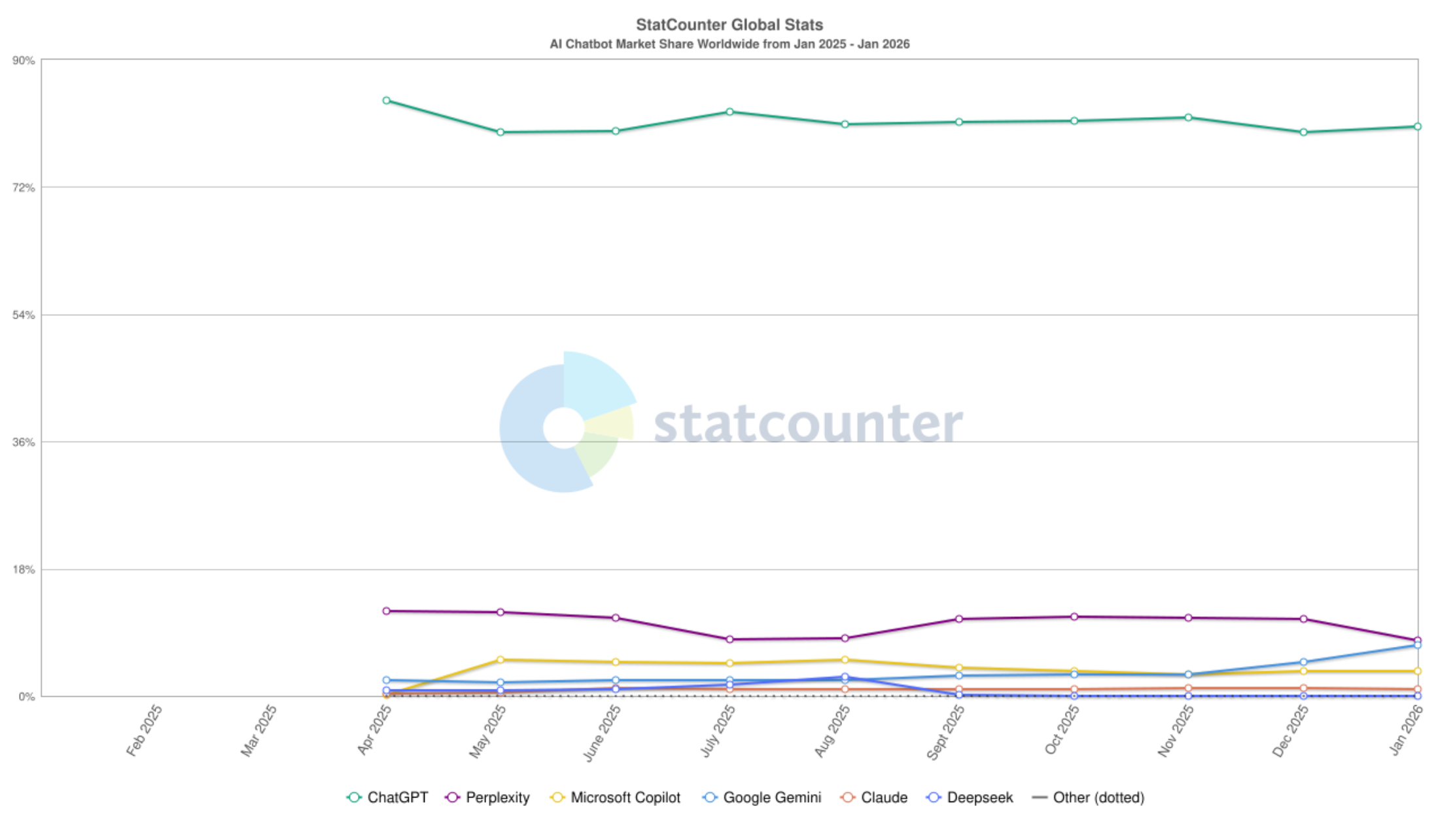
And that’s not to say that ChatGPT isn’t pulling in some impressive numbers (and yes, we’re using ChatGPT in this example because, as you can see below, it is the only AI system that could conceivably give Google a run for its money).
In fact, as of September 2025, ChatGPT was reportedly rolling in 700 million weekly active users, which is a metric buttload to be sure.
But when you consider the fact that Google is still getting up to 16.4 BILLION searches PER DAY, that metric buttload starts looking like small potatoes (or small butts?) real fast.
But that’s not even the real reason SEO isn’t dead, and excuse us if it sounds like we’ve been yelling from a soapbox this whole time. SEO isn’t dead because large language models use search engines like Google (and sure, Bing) to do the grunt work for them.
How AI Actually Retrieves Information
Large language models source their information in two ways: from pre-trained data and real-time internet ‘searches’.
Pre-Trained DataPre-Trained Data
Here, LLMS are trained on vast amounts of information available on the internet, as in website content, brand mentions, citations, and authoritative sources. For example, some put ChatGPT 4’s training data at 1 petabyte (that’s 1,000 terabytes or roughly 200,000 copies of Gladiator in HD).
Live Internet Data Retrieval
Remember back in the day when ChatGPT couldn’t answer anything that had to do with events that transpired after September 2021? Yeah, we don’t need to worry about that anymore. While LLMs don’t directly browse the internet the way humans do, they will access web data through APIs, retrieval augmented generation (RAG), and web scrapers to fetch, process, and feed external information into their context during inference.AI systems use things like semantic relevance, authoritativeness (cough E-E-A-T cough), content quality, and content freshness as part of their retrieval criteria.And well, whaddya know, doesn’t that sound like SEO?
SEO Is the Foundation of AI Visibility
If your pages aren’t being crawled or indexed by search engines, they’re not going to be picked up, retrieved, or cited by ChatGPT, Copilot, or Perplexity.
This is why we scoff, set our arms akimbo, and shake our heads whenever so-called pundits claim that investing in SEO in the age of AI is for chumps.
In fact, we say that SEO is still the very foundation upon which AI stands because it directly aligns with the three core pillars of SEO (technical, on-page, and off-page optimisation):
Technical SEO, because AI models rely on crawlable, indexable sites with fast load times, mobile optimisation, and structured data. Without these, content stays hidden from search crawlers that feed AI retrieval systems.
On-Page SEO, because semantic relevance and E-E-A-T signals make your pages understandable to both search engines and AI (oh yeah, and real folks). And because LLMs prioritise topically authoritative, well-structured content that follows on-page best practices when generating responses or citations.
Off-Page SEO, because backlinks and brand mentions build domain authority and signal trustworthiness to AI models. And because high-authority links ensure your content gets referenced in the datasets and knowledge graphs AI pulls from.
So nope, SEO isn’t dead just yet. And juuuuust in case you needed a little more proof, how about the fact that Anthropic, the brain behind Claude, recently posted this job listing for a full-time SEO lead.
Moving Forward in 2026
Want our unsolicited advice? Don’t throw the baby out with the bathwater. Don’t quit your day job to dropship fidget spinners. And don’t invest 100% of your marketing budget in generative engine optimisation.
Instead, use a mixed approach. Continue to invest in SEO with added GEO practices to ensure you’re laying the right foundations for traditional search while expanding your visibility surface into other platforms.
Genny Methot is Geeky Tech’s storyteller. She heads up our social media content, blog posts, and the Geek Speak podcast. Click here to learn more about Genny.
Shopping Basket
We use cookies on our website to give you the most relevant experience by remembering your preferences and repeat visits. Accept
Manage consent
Privacy Overview
This website uses cookies to improve your experience while you navigate through the website. Out of these, the cookies that are categorized as necessary are stored on your browser as they are essential for the working of basic functionalities of the website. We also use third-party cookies that help us analyze and understand how you use this website. These cookies will be stored in your browser only with your consent. You also have the option to opt-out of these cookies. But opting out of some of these cookies may affect your browsing experience.
Necessary cookies are absolutely essential for the website to function properly. These cookies ensure basic functionalities and security features of the website, anonymously.
Cookie
Duration
Description
cookielawinfo-checkbox-analytics
11 months
This cookie is set by GDPR Cookie Consent plugin. The cookie is used to store the user consent for the cookies in the category "Analytics".
cookielawinfo-checkbox-functional
11 months
The cookie is set by GDPR cookie consent to record the user consent for the cookies in the category "Functional".
cookielawinfo-checkbox-necessary
11 months
This cookie is set by GDPR Cookie Consent plugin. The cookies is used to store the user consent for the cookies in the category "Necessary".
cookielawinfo-checkbox-others
11 months
This cookie is set by GDPR Cookie Consent plugin. The cookie is used to store the user consent for the cookies in the category "Other.
cookielawinfo-checkbox-performance
11 months
This cookie is set by GDPR Cookie Consent plugin. The cookie is used to store the user consent for the cookies in the category "Performance".
viewed_cookie_policy
11 months
The cookie is set by the GDPR Cookie Consent plugin and is used to store whether or not user has consented to the use of cookies. It does not store any personal data.
Functional cookies help to perform certain functionalities like sharing the content of the website on social media platforms, collect feedbacks, and other third-party features.
Performance cookies are used to understand and analyze the key performance indexes of the website which helps in delivering a better user experience for the visitors.
Analytical cookies are used to understand how visitors interact with the website. These cookies help provide information on metrics the number of visitors, bounce rate, traffic source, etc.
Advertisement cookies are used to provide visitors with relevant ads and marketing campaigns. These cookies track visitors across websites and collect information to provide customized ads.