What Is SEO and How Does it Work?

HomeGeek SpeakSEOWhat Is SEO and How Does it Wo...

Sick of Bull****it advice blog

TL;DR: SEO is the process of improving a website to rank higher in Google’s free, organic search results. It rests on three pillars — keyword research, on-page optimisation, and off-page authority (backlinks) — and matters because Google handles ~90% of global search traffic.

I’ve been in SEO long enough to know the problem isn’t a shortage of advice — it’s that most of it is complete bullsh*t. Recycled tips, outdated tactics, and “hacks” that stopped working years ago.


This short guide is my attempt to cut through that. No jargon for jargon’s sake, no gatekeeping — just a straight explanation of how SEO actually works, from someone who runs an agency that does this for a living.


If you have a website or online business, understanding this properly will save you time, money, and a lot of bad advice.

What Is SEO?

SEO stands for search engine optimisation, and it entails any process that strengthens your website’s visibility on search engines. Strictly speaking, SEO encompasses any unpaid, earned, or organic efforts.


Essentially, SEO is anything that Google uses in its algorithm to determine where a website should rank in the organic results.


So, for example, if you have a website that offers coding challenges, your target audience will be searching for phrases such as ‘Python programming challenge’, ‘PHP coding challenges’ or ‘Java coding challenge’.


Of course, you want your website to be showing up in these results, and good SEO can make that happen by ensuring you’re one of the first websites (if not the first) your audience will see.This will mean more leads are making their way to your website.

Why Does SEO Focus on Google?

Google is where most of the people are. As of May 2026, Google holds approximately 90% of the global search engine market (StatCounter Global Stats), a share that’s remained remarkably stable for over a decade. It’s Mr. Monopoly and all the other guys are lucky to get Park Place.

Why Do So Many People Use Google to Search?

At the risk of oversimplifying things, it’s because it works well and it provides much better search results than any of its competitors.


It wasn’t until early 2010 that Bing even became competitive and provided search results of similar quality. But by then, it was too little too late—Google was already an established powerhouse. People associate search with Google—it has even become its own verb, for crying out loud—and Bing still hasn’t managed to gain any significant search share….sorry, Bing.


Google processes billions of search queries every single day, and roughly 15% of those searches have never been typed before (Google Search Overview and Improvements).

What Makes Google’s Results So Good?

Most people think it’s highly complex, top-secret formulas only understood by Google’s geekiest geniuses.


But, it’s actually not as complicated as you might think. To quote Google, ‘You want the answer, not billions of web pages.’


Google’s ranking systems sort through the hundreds of billions of sites in their search index to give you useful and relevant results in a fraction of a second.


These ranking systems are made up of a whole series of algorithms that look at multiple factors including:

So, in order to rank in Google, you need your site to have an impact on those ranking algorithms. In plain terms, you gotta work the system, baby.  

Empower your decision-making with SEO knowledge.
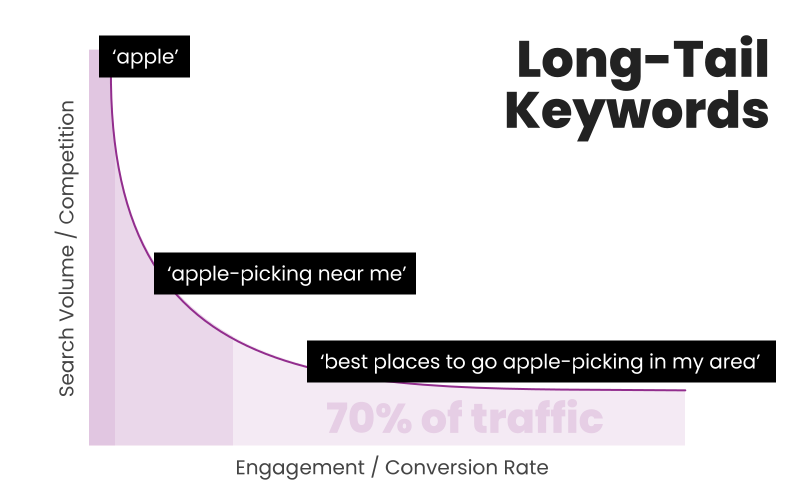
Learn more about keyword research and strategy in our SEO Fundamentals series.
long tail Artboard 3 1

Why Does SEO Keep Changing?

Google’s ranking systems weigh many different signals and factors to determine relevance — including the words in your query, the usability of a page, the expertise of its source, and your location — though Google has never published an exact count of ranking factors (A guide to Google Search ranking systems).


Each year, Google changes its search algorithm around 500–600 times. While most of these changes are minor, Google occasionally rolls out a major algorithm update that can have a significant effect on the search results.

How Does Google Make Money From Search?

This can all seem a bit complex and, well, quite overwhelming. Ranking factors aside, let’s try to take a common-sense approach to understanding exactly what Google wants.


Like any business, Google’s main priority is profit. How does it make its money? By placing ads at the top of page one. 


But ultimately, it’s the quality of the organic search results that drives the huge volume of people to the site, which is why so many advertisers want to spend money on Google ads in the first place.

What Are the 3 Fundamentals of SEO?

Successful SEO really boils down to three things: keyword research, on-page optimisation, and off-page optimisation.


Here’s the summary table to help you understand what each of them covers:

Pillar What it covers Goal
Keyword Research Understanding customer language, competitor terms, ranking feasibility Know what to rank for
On-Page Optimisation Content, meta titles, headings, internal links, site structure, UX/technical fixes Make the page rank-ready
Off-Page Optimisation Backlinks, mentions, referral traffic from authoritative sites Prove trust and authority externally
#1: Keyword Research

Researching the right keywords for your site is really all about understanding:

  • Who your customers are
  • The terminology they use to search within Google
  • Who your competitors are for those terms
  • If your website can compete for those terms

Once you know all that, you then develop a strategy for ranking your website for those terms.

#2: On-Page Optimisation

After you work out exactly what you want to rank for in Google, you’ll need to optimise your website for that search term. This includes:

  • Keywords
  • Variations of that keyword
  • LSI Keywords (which is how search engines understand relevancy and context and know the difference between ‘hot dog’ and ‘hot’ and ‘dog’)
  • Content and site structure
  • Meta titles
  • H tags
  • Anchor texts
  • Image optimisation
  • Page structure
  • And more

In its most basic form, on-page optimisation is making sure you’ve got the right word on the right part of your site for Google to rank you.


But that’s not all! On-page SEO is where we fix technical bugs and improve your site’s user experience (or UX). For example, in this step, an on-page SEO specialist will make sure you don’t have any broken links and that all your site images have alt attributes…all in the name of higher rankings.


It all gets pretty geeky, and if you want to learn more about how on-page SEO works, check out SEO Fundamentals: Understanding On-Page Optimisation.
#3: Off-Page Optimisation or Off-Site SEO

Now that you’ve worked out exactly what you want to rank for and you’ve created loads of incredible content that Google will love, off-page SEO makes sure you have enough external signals outside of your own website to justify or validate whatever claim your content is making.


This is often referred to as trust, credibility, or authority.


Your authority is typically going to come from a combination of links (often called backlinks), mentions, and traffic to your website. Your backlinks should ideally come from other high-authority websites because their links hold more value.

What Have We Learned About SEO?

To summarize, search engine optimisation can be broken down into three main objectives:

Thanks for reading, everyone. I’m going to follow up with more blogs and videos that take a deeper look at each of the three fundamental areas of SEO, and I want to give you some actionable advice you can use for your site. Stay tuned!

Looking for hacks to speed up your marketing efforts?
Listen to our very first episode of SEO Unfiltered where we unpack the SEO basics.
Blog post – 1
Read Next
Share This Post
Facebook
LinkedIn
Twitter
Email
About the Author
Picture of Ben Hawkshaw-Burn
Ben Hawkshaw-Burn
Ben Hawkshaw-Burn is one of the co-founders of Geeky Tech. We are an SEO agency that helps world-changing technology companies attract new customers using Google. Learn more about Ben here.
Shopping Basket

Unlock AI brand intelligence with GeekyIQ

Complete your AI visibility workflow in a single platform